


In the AI universe, no one can figure out what The Plan™ is, let alone what it's going to be.


What I thought was a relatively innocent comment, "Show us the proof," to the assertion that "Paul Krugman has an extremely poor track record with predictions" turned into a demand that I disclose that I am "a jew." Not satisfied to leave it there, another commenter joined in to call me a "faggot boi" based on my Substack posts.
This is the relevant section of the content guidelines:
Hate
Substack cannot be used to publish content or fund initiatives that incite violence based on protected classes. Offending behavior includes credible threats of physical harm to people based on their race, ethnicity, national origin, religion, sex, gender identity, sexual orientation, age, disability or medical condition.
Clearly, Substack has a serious harassment/hate speech problem. Report an issue and they promise not to let you know how it was decided. Seriously. They will not share what if any action was taken when you report a content violation.
So, what's a content creator to do? I can tell you that this one will move all of his posts off Substack and delete his account before it turns into Twittter with subscriptions.
ETA: I flagged the comments, Tyler from Substack replied, and I responded to his e-mail.
.png)
Departures is Pillion without the humor.
The theme song is “Bad Romance,” over and over. I would have walked out if I hadn’t paid for the ticket.
It’s as if your friend with self-esteem issues (Benji, Lloyd Eyre-Morgan) tells you in excruciating detail about the dead-end relationship that just ended. As he tells the story, you can spot every red flag that he ignored but he was so besotted that he just plowed right ahead. As relationships go, it wasn’t much of one, made up of eight marijuana-laced and boozed-up weekends in Amsterdam with an enigmatic 40-something hunk (Jake, David Tag), one a month. From the start, when your friend couldn’t tell if the guy was even gay and he brought a hooker to the apartment soon after they unpacked, it was clear that there was no way it could go on.To no one’s surprise it didn’t, and to your great relief it looked he found a way to get over it. In Greek drama that’s known as a deus ex machina, and here he’s named Kieran.
The usual disclaimer about the characters in the movie not resembling anyone living or dead ends the movie. Since Lloyd Eyre-Morgan is the screenwriter, co-director, and lead I have my doubts.
Finally, I have a bone to pick with New York Times film critic Chris Azzopardi. U.K. distributor Peccadillo Pictures touted Departures as a New York Times Critic’s Pick in a recent email and that made me think I needed to see the movie before it left the IFC Center. Azzopardi wrote, “A voice to watch, Eyre-Morgan wrote Departures and directed it with Neil Ely. The film balances a mordantly funny deconstruction of romance with the harsher realities of gay life: internalized homophobia, body dysmorphia, alcoholism, sexual abuse, parental expectations to be a “happy gay.” It’s a lot, maybe too much for some. Even the camerawork feels confrontational, with tight close-ups and high angles that subjugate Benji. Departures is still tender and winsome, with graphic-novel-style animation lightening the load, but is ultimately punishing in tone. It lives by a truth that might ring familiar for gay men particularly: Humor that cuts deep is a form of survival.”
First of all, there’s nothing funny, let alone “mordantly funny.” And it’s neither tender nor winsome, though it is definitely punishing. I felt undeservedly punished at many points of its 82 minutes that felt more like 102. “Humor that cuts deep is a form of survival”? Puh-leeze, Chris. If you can show me the humor, then we can discuss how it’s a form of survival.
After that review, Chris Azzopardi joins The New Yorker‘s Richard Brody as a critic to ignore. Read the full review here (gift link): ‘Departures’ Review: Finding Levity Amid the Pain.

Marty Supreme is driven by romance, and the thinness of its central couple’s relationship—the one that begins and ends the movie—is compensated for by its thematic implication of a bond of ineffable absoluteness, a passion beyond words. In this regard, Marty Supreme, set in 1952, reminds me of one of that era’s great movies, Rear Window, in which Alfred Hitchcock offers, in a monologue spoken by the superb character actress Thelma Ritter, a definitive credo of transcendentally carnal love. But, Marty Supreme, true to its title and its eponymous character, isn’t a women’s picture; the romance, sharply conceived though it is, is ultimately little more than a series of obstacles on the protagonist’s athletically existential journey.

Hamnet, though its title may suggest otherwise, is very much Agnes Shakespeare’s (Jessie Buckley) movie, supported by Paul Mescal as Will and the astonishingly precocious Jacobi Jupe as the titular Hamnet. As for what it’s about, think “Scenes from a 17th-century Marriage” meets “Front Row at Hamlet“ and “Front Row at Hamlet“ takes the prize. The “Scenes...” scenes are far less involving, despite the trials and sorrows of the Shakespeares’ marriage.
This may be a minority opinion, but it seemed to me that the pacing of the opening two-thirds was off. Director Chloé Zhao is too methodical in setting up how Will and Agnes meet cute, marry and start a family. Too much of the film’s two-hour-plus running time is devoted to undramatic domestic interaction. Then boom! Out of nowhere Agnes is fighting the plague with herbs and cold compresses. Take away the period setting and it could be about a businessman who spends too much time at the office while his wife is raising the family in the suburbs. Instead, you have William Shakespeare living in London while he establishes himself as a playwright.
After the Elizabethan equivalent of a kitchen-sink play, the action moves from Stratford-on-Avon to London and the dramatic and emotional high point of the film. Agnes learns that Will’s company will premiere a play named after their son, and sets out for the first performance of Hamlet at the Globe, accompanied by her brother Bartholomew (Joe Alwyn). There, amidst the groundlings, she sees for apparently the first time what her husband is capable of. And possibly for the first time we see how Shakespeare has taken his grief and put it into the play, a play we thought we knew and understood.
A great part of the emotional impact of the final section comes from Noah Jupe’s understated performance of the excerpts from Hamlet that end the movie. Another standout is Joe Alwyn as Bartholomew. He was always welcome for the gravity and empathy he brought to the scenes he was in. They add ½⭐️ to the Letterboxd star score.
Hamnet is nominated for Academy Awards in the following categories: Motion Picture of the Year, Achievement in Directing, Performance by an Actress in a Leading Role, Adapted Screenplay, Original Score, Production Design, Costume Design, and Casting. It won Golden Globes for Motion Picture - Drama and Performance by a Female Actor in a Motion Picture - Drama for Jessie Buckley.
Aside from "everything," of course
I rarely disagree with Heather Cox Richardson but I’d say blunders are guaranteed. From what we’ve seen so far from the regime, I’m quite comfortable saying that “Blunders ‘R’ Us” describes their M.O.
Source: Heather Cox Richardson, “Notes from an American,” 1/3/2026
https://open.substack.com/.../heather.../p/january-3-2026...

Nothing whatever to do with the Epstein Files
I knew we’d seen this movie before. By the way, in case you might think so for some odd reason, it has nothing to do with the Epstein Files. You couldn't be more wrong.


I haven’t seen many movies this month, so it was a treat to get to The Museum of Modern Art for Eleanor the Great Monday afternoon. It was part of The Contenders 2025 series. I had thoughts, and here are some of them. No big spoilers.
Overheard after the movie: “I could really relate to it. Lying was one thing my family was good at.” Eleanor’s lies are told with the best of intentions, which somewhat justifies them. They’re still lies, though, so she does pay a price. The script by Tony Kamen doesn’t just tug on the heartstrings, it gets them in a vice grip and doesn’t let go. That said, though the happy ending is a bit too pat, it didn’t bother me.
Worth seeing for June Squibb and the rest of the cast. Overall, a well-done first feature by Scarlett Johansson.
No longer in theaters, as far as I can tell, it can be streamed just about everywhere.
If you’re not gaga over AI, you’re not alone.
Let me rephrase that. If you think AI is the greatest thing since sliced bread, you are pretty much alone. Josh Marshall has the data.
“As this Politico piece from a couple days ago points out, something like 80% of Americans think AI should be robustly regulated and fewer than 20% of Americans think AI will have a positive impact on America over the next 20 years. These are shocking numbers, to put it mildly. AI is running only slightly ahead of child molesters in the public imagination.”
Here’s a story that wasn’t reported anywhere that I saw. You can call me crazy if you want to, but I sense a trend.
Thanks to Amanda’s Mild Takes‘ “*****’s for the Week.”
Candidates backed by blue money prevail in red city elections
.png)
As Manchester’s Army buddy, Steve (LaKeith Stanfield), says of him, “We both know that doing things the right way is not your superpower.” He or someone else says that Manchester is some kind of genius and really dumb at the same time. That is played out again and again, as Manchester gets away with something thanks to his superb observation and planning skill, only to put himself in jeopardy because what he wants more than anything is a family and the love of a good woman. The ride that director Derek Cianfrance takes the audience on spends a considerable chunk of the movie on Manchester’s winning over Leigh’s daughters, to show, apparently, that he’s a softie at heart.* It also explains the ending, which is well telegraphed yet comes as something of a surprise.
Roofman is well worth seeing for Channing Tatum’s charismatic performance, both clothed and — SPOILER ALERT! — nude. Actually, to correct what I said about there being nothing funny about it, the sequence when store manager Mitch (Peter Dinklage) discovers Manchester standing right in front of him is funny.
Rated R for language, nudity and brief sexuality. Apparently no animals were harmed, though the only animal I saw was a duck that Manchester feeds in the prison yard. As for explosions, no cars were blown up. However, there is a spectacular fireball that’s caused by Manchester’s inexperience as an arsonist.
* A producer and a writer were in a meeting. The producer says, “I love the script, I think it’s great. I’d like you to make the kid more sympathetic.” The writer says, “Sure. what did you have in mind?” The producer says, “Give him a puppy. Give him a limp.” The writer says, “Give the puppy a limp?” The producer says, “How the hell should I know? You’re the writer, you figure it out.” Shorthand: “Give the puppy a limp” for make a character sympathetic, as Cianfrance and co-writer Kirt Gunn do for Manchester.
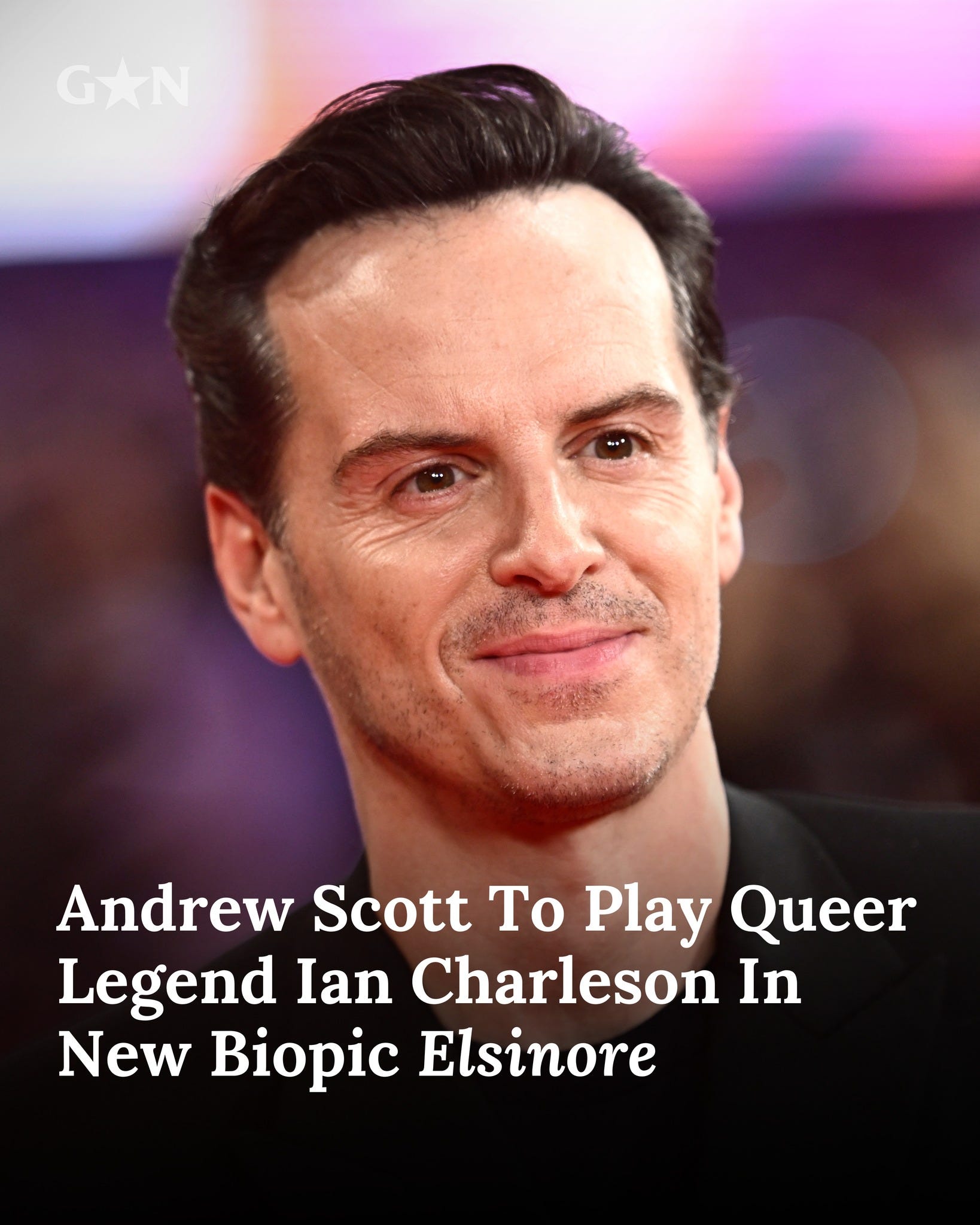
From Gay Star News’ Facebook news feed:
Andrew Scott to play gay icon Ian Charleson
Andrew Scott is preparing to take on what is already being described as a career-defining role, portraying revered Scottish actor Ian Charleson in Elsinore, a newly announced biographical drama from StudioCanal, first reported by Variety.
The film will be directed by Simon Stone, who makes the leap from actor to filmmaker, with a script by BAFTA-winning writer Stephen Beresford, best known for Pride. Together, they focus on the final and most intense period of Charleson’s life, as he prepared for and delivered a legendary turn as Hamlet while living with AIDS.
Scott will also serve as a producer on the project, deepening his creative involvement beyond the screen. His casting has been met with widespread acclaim, with Stone calling the pairing of actor and subject a rare alignment. “Andrew Scott is one of the greatest actors of his generation,” he said, drawing a direct parallel to Charleson’s own standing in British theatre.
While Charleson reached global audiences through Oscar-winning films such as Chariots of Fire and Gandhi, his most enduring impact was forged on stage, where his performances — particularly in Shakespeare — secured his reputation as one of the great actors of his era.

I don’t know what all the fuss is about a few little redactions. It’s the most transparent regime—I mean “administration”—in American history, maybe since the Roman Empire
Gallup has surveyed voters on what they think about the president since Harry Truman was in the White House. TL, DR: It’s looking bad for the Dotard Leader. Here’s an excerpt from Ed Kilgore’s article in New York magazine.
“A quick scan shows that *****’s terrible standing among independents right now places him in some dangerous territory.
“To start with, that 25 percent job-approval number among independents is significantly lower than any ***** registered in Gallup’s monthly surveys during his first term. His job-approval rating among independents was at 39 percent the day he lost his 2020 reelection bid. And it was still at 30 percent in January of 2021, immediately after the January 6 Capitol Riot made him look dead politically for a good while. He’s in uncharted territory right now.
“Let’s compare this terrible standing among the unaligned with the famously unpopular presidents of the past. At this same point in his one term as president, Joe Biden’s job-approval rating among independents was 37 percent. It hit an all-time low of 27 percent among independents in November 2023, before improving back to 37 percent by the end of his term. George W. Bush actually did worse late in his second term when the bottom was falling out of the economy; his October 2008 job approval among independents was at 19 percent, but that wasn’t much worse than his 25 percent approval rating among all voters. Bill Clinton briefly plunged below 30 percent among independents during his rocky first few months as president, but he was up to 44 percent prior to a disastrous 1994 midterm election and eventually 67 percent by the end of his presidency. Richard Nixon didn’t reach *****’s low levels of job approval among independents until he was in the depths of the Watergate scandal; he hit 23 percent when impeachment proceedings against him began and 22 percent the day he was forced to resign.”
Read the article here after you prove you’re not a robot: https://nymag.com/intelligencer/article/*****'s job approval among independents is astoundingly low
CONTENT WARNING: This is a real downer, and it’s just five paragraphs from the entire article.
“As all of this unravels, the turkey psychodrama, the imaginary borders sealed to perfection, the SWAT-team-for-my-girlfriend subplot, the re-litigation of last year’s poultry, the self-contradictions delivered back-to-back without a blink, it’s impossible to ignore the larger, more chilling truth hovering behind every one of these public appearances. This isn’t just chaos; it’s disorganization. Deep, unspooling, unmistakable disorganization from a man who holds the nuclear codes.
“Every part of that turkey-pardon performance ricocheted like a pinball machine on the fritz: One moment he’s bragging about patio stones, the next he’s invalidating ceremonial pardons, then he’s insisting the border is at ‘zero,’ then he’s ranting about Chicago murders, then he’s praising a prison in El Salvador, then he’s promising $2 gas, then he’s declaring he ended ‘eight wars in nine months,’ then he’s doing stand-up about fat governors. It’s not just off-topic; it’s untethered. The through-line isn’t policy; it’s impulse.
“And that’s the part that should keep everyone up at night. We’re not watching a man who loses the plot. We’re watching a man who no longer seems aware that plots exist. This is someone who jumps between fantasies, vendettas, hallucinated statistics, and self-congratulation with the ease most of us change radio stations. That is frightening enough at a Thanksgiving sideshow. It is catastrophic when the same man can, on a whim or a misunderstanding or a perceived insult, initiate decisions with global consequences measured not in ‘crime statistics’ but in megatons.
“There’s a point where this stops being funny, even in a country that copes with gallows humor as a national pastime. There’s a point where the disjointedness stops being a quirk and becomes a risk. We passed that point a long time ago. What we saw at the turkey pardon wasn’t just a rambling holiday speech; it was a man broadcasting, openly and without disguise, that he is no longer capable of holding a coherent idea for more than thirty seconds.
“The danger is that the most disorganized speaker in American public life remains the one person empowered to make the kind of decisions you need absolute clarity for.”
“Thanksgiving on Thin Ice” by Mary Geddry from Geddry’s Newsletter, 11/25/2025

Imagine if someone had a Christmas Eve party and invited all the clichés they knew. If the party was held in a gay bar, you’d have Some of My Best Friends Are.... “Stereotype” would be a better description if one was being kind, and really ...My Best Friends... did the best that could be done at the time. Those people existed and they faced the same challenges the movie’s characters did.
Why to watch:
• A picture, albeit slanted, of gay life in the 1970s
• Fannie Flagg as the coat-check attendant
• Rue McClanahan as a nasty piece of work
• Sylvia Syms as the beloved cook
• Gary Sandy (WKRP in Cincinnati) as a hustler
• most notably, Candy Darling, who steals every scene she’s in
Why not to watch:
• Some characters get lost in the myriad subplots
• Many cringe-worthy though historically accurate situations
• Wildly varying performances

Behind "Oklahoma!" lies the remarkable story of gay Cherokee playwright Lynn Riggs
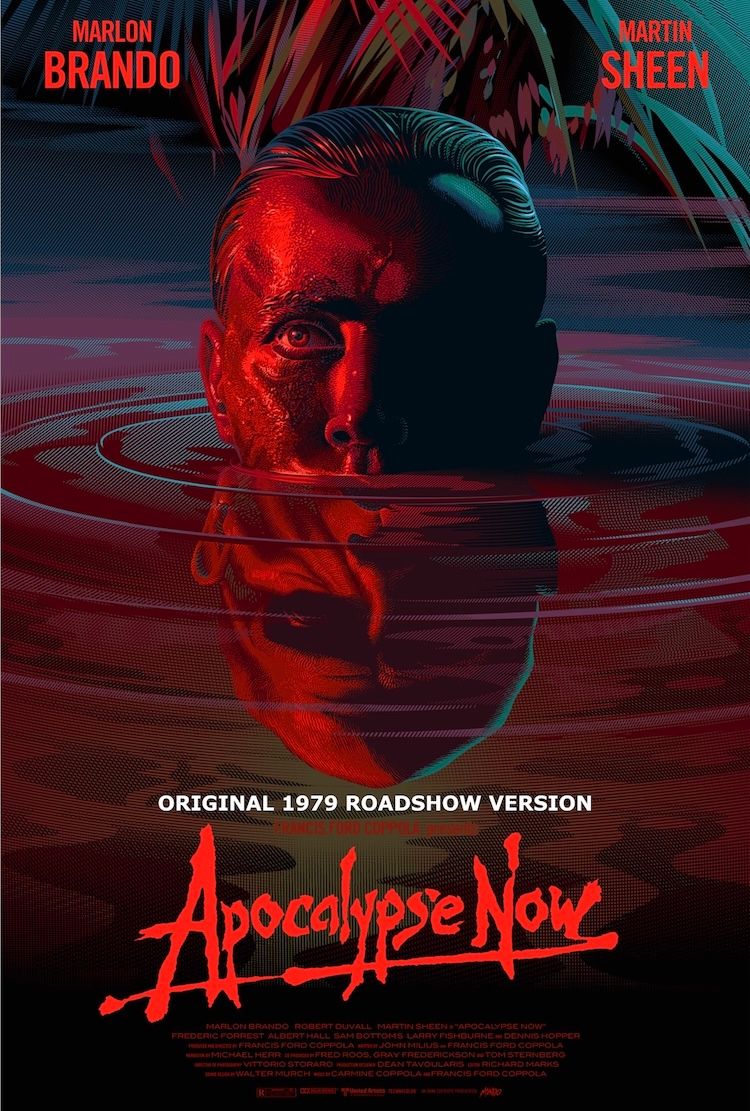
After seeing Megadoc, Mike Figgis’ documentary charting the making of Coppola’s most recent feature, Megalopolis, just the other day, I can see parallels between the two movies, despite their being made more than 40 years apart. From the evidence of the two movies, I’d say that Coppola is more interested in big themes than simple stories; in an epic scope rather than human scale; and in spotlighting operatic violence, even buckets of blood, whenever possible. He strives to reach 11 on a scale of 10, and succeeds more often than not, leaving the audience gasping in his wake. I believe the Sicilian word is stonnat' or stunned.
To recap the plot, Apocalypse Now takes place during the Vietnam War and is about Captain Willard (Martin Sheen), who is sent up the Nung River to find Colonel Kurtz (Marlon Brando), a renegade Green Beret who’s conducting a private war from a base in Cambodia. Along the way, Willard witnesses and participates in a string of horrific war crimes that do nothing to advance the plot, but pretty effectively traumatize the audience much as the war traumatized the soldiers who fought in it. Finally, he finds Kurtz’s base and at that point the movie turns into a dramatization of Joseph Conrad’s Heart of Darkness, which was set in the Belgian Congo at the time of King Leopold’s worst atrocities. Not only is Kurtz certifiably insane, but a photographer (Dennis Hopper) is loose on the property and he’s floridly psychotic as only Hopper can be. Kurtz takes Willard prisoner, tortures him, then frees him, and (no spoilers) Willard has to decide if he’s going to carry out his mission. In the meantime, an ox is ritually slaughtered, serving as an on-the-nose metaphor and yet another spectacular set piece.
Coppola made Apocalypse Now, at considerable personal cost, to put the war on the screen. It was his answer to the question posed in Norman Mailer’s book Why Are We in Vietnam?, and unlike Mailer, whose answer was that the war was sublimated homosexual dominance on a grand scale, Coppola showed what the war looked like and how it destroyed the people who were sent to fight it. Tens of thousands were killed, the rest were traumatized.
The problem for me after my first viewing was that beyond showing how Captain Willard, who starts out pretty unhinged (he bloodies his fist by punching a mirror in a drunken stupor in the movie's first 10 minutes), ends up nearly catatonic after he leaves Kurtz’s compound, it seemed like there wasn’t anything else to take away about the characters. With some reflection, I changed my mind.
Willard starts out damaged and ends up wrecked by what he’s been through and what he’s had to do. The surfer, Lance (Sam Bottoms, Timothy Bottoms’ brother), is similarly wrecked, though his LSD trips shield him from the worst of the carnage he’s witnessed and participated in. And the audience should be touched in a similar way, though some people may remember the visuals more clearly than the message. This isn’t surprising, since Coppola’s message is widely understood today, more than when the film was released.
For many viewers, the spectacle is enough—the helicopter ballet to Wagner’s Ride of the Valkyries gave me goosebumps, the explosions were lovely, and Kurtz’s compound in a Cambodian ruin was beautiful. That Apocalypse Now is more than this, that Captain Willard becomes an empty shell to cope with his experience inside the heart of darkness, is a testament to John Milius’ script and Coppola’s vision as a director.


